Sailing Basics for Beginners | Master Seamanship Principles
VERIFIED TECHNICAL REFERENCE
ABYC STANDARDS COMPLIANT • 2026 AUDIT
Lead Technical Reviewer:
Elena Rostova, M.Eng., ABYC Master Tech
Maritime Command Review:
Capt. Robert H. Vance, USCG 100-Ton Master
Methodology:
OEM Factory Service Manual Cross-Check
Last Revision:
September 2026 (Annual Editorial Cycle)
Foundational Seamanship Curriculum
Designed for novice skippers and coastal day-sailors, this guide covers essential terminology, COLREGS navigation rules of the road, and heavy-weather safety protocols.
The Points of Sail Explained
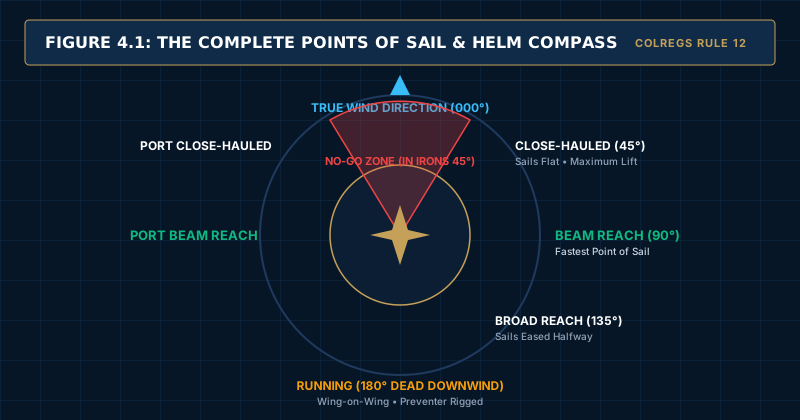
Understanding how your vessel relates to the true and apparent wind direction is the core foundation of seamanship:
- In Irons (No-Go Zone): The 40 to 45-degree cone directly into the wind where sails cannot produce aerodynamic lift.
- Close-Hauled (Beating): Sailing as close to the wind as aerodynamic design allows (approx. 45 degrees), sails sheeted tightly flat.
- Beam Reach: Sailing at a 90-degree angle to the wind; the fastest and most stable point of sail for most hull geometries.
- Broad Reach: Sailing at approx. 135 degrees from the wind with sails eased halfway and centerboard/keel loads reduced.
- Running (Dead Downwind): Sailing with the wind coming directly from astern; requires a boom preventer to guard against accidental jibes.
Critical Docking Maneuvers Under Wind & Current
Always approach the dock against the prevailing element (either wind or tidal current, whichever exerts the stronger vector). Use spring lines to arrest vessel momentum rather than relying on crew muscle power.
Editorial Quality Assurance & Errata Reporting
SailingManuals maintains strict engineering accuracy protocols. If you identify an outdated torque specification, superseded OEM part number, or wish to submit a manufacturer service bulletin, please contact our review board.
Submit Technical Errata or OEM Bulletin →