The Master Sail Trim & Rigging Guide | SailingManuals Classic
Download Master Sail Trim & Rigging Aerodynamics Card (PDF)
Vector Quick-Reference Sheet • ABYC Compliant • Printable Workshop Reference Card
Historical Archival Masterwork • Preserved Since 2000
First published in November 2000 by renowned cruising skipper Don Guillette and digitized on SailingManuals.com, this authoritative guide deconstructs sail trim aerodynamics, slot effect dynamics, and rig tuning protocols for modern monohulls and catamarans.
The Aerodynamic Physics of Sail Trim: Lift vs. Drag
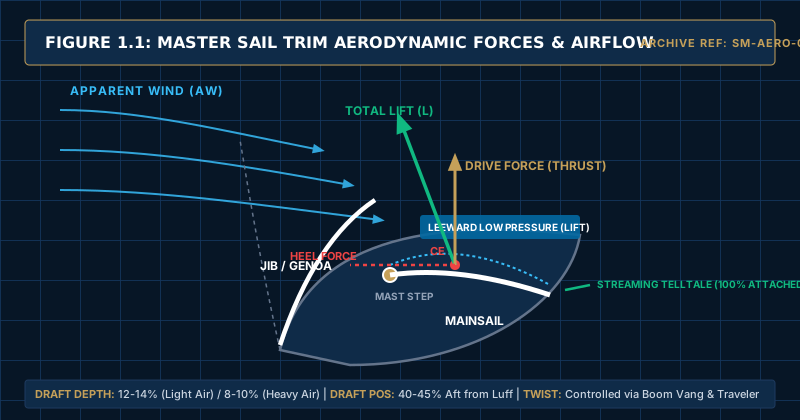
A sailboat's propulsion system does not operate primarily by wind pushing against cloth. When sailing close-hauled or on a beam reach, sails function precisely like aircraft wings. As air flows across the curved profile of the mainsail and jib, it travels faster over the leeward (outer) curved side than the windward (inner) flatter side. This velocity differential generates a low-pressure pocket on the leeward surface, creating aerodynamic lift perpendicular to the chord line of the sail.
The art and science of sail trim revolve around optimizing this lift while minimizing parasitic drag, turbulence, and induced heeling forces that compromise vessel stability and hull speed.
The Five Essential Sail Controls & Their Mechanical Functions
1. Draft Depth (Camber) Control
Draft depth refers to the maximum depth of the curve between the luff and leech. In light air (4–9 knots) and choppy seas, a deeper draft (fuller sail) generates the high lift necessary to power through wave action. In heavy air (18+ knots), draft must be flattened aggressively to prevent overpowering the vessel and causing excessive leeway and weather helm.
- Outhaul: Tightening the outhaul flattens the lower third of the mainsail; easing it adds full belly for downwind runs.
- Backstay Adjuster: Bends the mast middle forward, simultaneously flattening the mainsail middle and tightening the forestay to reduce jib luff sag.
2. Draft Position (Fore-and-Aft Center of Effort)
The maximum camber of a sail should generally sit between 40% and 45% aft from the luff. As wind speed increases, wind pressure naturally blows the draft backward toward the leech (55%–65%), inducing severe heel and weather helm.
- Halyard Tension: Pulling halyard tension pulls the draft forward toward the luff.
- Cunningham: Enables fine-tuning of draft position without altering mainsail hoist height on the gooseneck.
3. Twist Control (Angle of Attack Across Altitude)
Because wind velocity increases with altitude above sea level (due to reduced surface friction with waves), the apparent wind angle shifts further aft higher up the mast. To keep the sail trimmed properly from foot to head, the upper portion of the sail must twist open at a wider angle than the lower portion.
- Boom Vang: Controls mainsail twist when off the wind (reaches and runs) by preventing the boom from lifting.
- Main Traveler: Controls the boom angle of attack relative to the centerline without affecting vertical leach tension (twist).
- Jib Sheet Lead Cars: Moving cars forward pulls down on the jib clew (reducing twist); moving cars aft opens the top of the jib (increasing twist).
Reading Telltales with Precision
Telltales are your real-time aerodynamic telemetry sensors attached to the luff of the jib and the leech of the mainsail:
- Windward Telltale Fluttering: Sail is under-trimmed or the helmsman is pinching too high into the wind. Sheet in or bear away slightly.
- Leeward Telltale Stalling / Drooping: Sail is over-trimmed; airflow on the low-pressure side has detached into turbulent vortexes. Ease the sheet immediately.
- Top Mainsail Leech Telltale: Should stream straight aft 80% to 90% of the time on a beat, stalling intermittently to confirm optimum leech tension.
Editorial Quality Assurance & Errata Reporting
SailingManuals maintains strict engineering accuracy protocols. If you identify an outdated torque specification, superseded OEM part number, or wish to submit a manufacturer service bulletin, please contact our review board.
Submit Technical Errata or OEM Bulletin →